
Running Your First Daggerheart Session: A GM Starter Guide
Daggerheart is designed to make the GM's job easier, not harder. The system does a lot of the dramatic lifting through its Hope and Fear economy, so your main job is to frame compelling scenes, respond honestly to what the players do, and spend Fear at the right moments. Here is how to run a smooth first session.
Prep situations, not scripts
Resist the urge to plan exactly what happens. Daggerheart is a conversation, and the best sessions emerge from player choices colliding with problems you set up. Instead of a scene-by-scene script, prep two or three situations: a threat that is actively unfolding, a location with interesting features, and an NPC with a conflicting goal. Let those elements meet the players in real time.
Also prep your adversary statblocks in advance. Each adversary has HP, an attack, a special ability, and a move the GM can trigger by spending Fear. Know what each one wants to do, so you can play it decisively without stalling to think.
Framing scenes
Start each scene in the middle of the action, not in the hallway before the door. Describe what the characters' senses pick up, then ask an open question. "The forest road ends at a burned-out farmhouse. Smoke still rises from the rafters. What do you do?" That gives players something concrete to react to and signals that the world is already moving.
When a scene has achieved its purpose, cut away. Daggerheart scenes do not need tidy housekeeping endings. Say "time jumps forward" and start the next one.
Using Fear
Fear is your most important tool. You gain it whenever a player's Fear die beats their Hope die on a success. You can also gain Fear when players mark Stress voluntarily for a benefit, or by triggering specific adversary abilities. The discipline that matters most is spending it proactively. If Fear piles up unspent, the tension never lands.
| Spend Fear to | At the table this looks like |
|---|---|
| Make an adversary move | An enemy attacks, repositions, or calls for backup. |
| Trigger a special ability | A statblock's marked move fires: a breath weapon, a curse, a summon. |
| Complicate the scene | The rope bridge frays, reinforcements arrive, a torch burns out. |
If Fear piles up unspent, you are not playing the system. Daggerheart's tension lives in the GM spending Fear at uncomfortable moments.
Managing the spotlight
Daggerheart does not use rolled initiative. Instead, after each player action resolves, you decide whether an adversary acts next, a player acts, or the environment reacts. This is the spotlight.
Give each player a meaningful moment every few minutes. If one player is dominating and another has not acted in a while, point a situation at the quiet one: "While this is happening, something moves in the shadows near you, Teri. What do you do?" Pacing the spotlight evenly prevents the common pitfall where one bold player carries every scene while the others watch.
Running adversaries
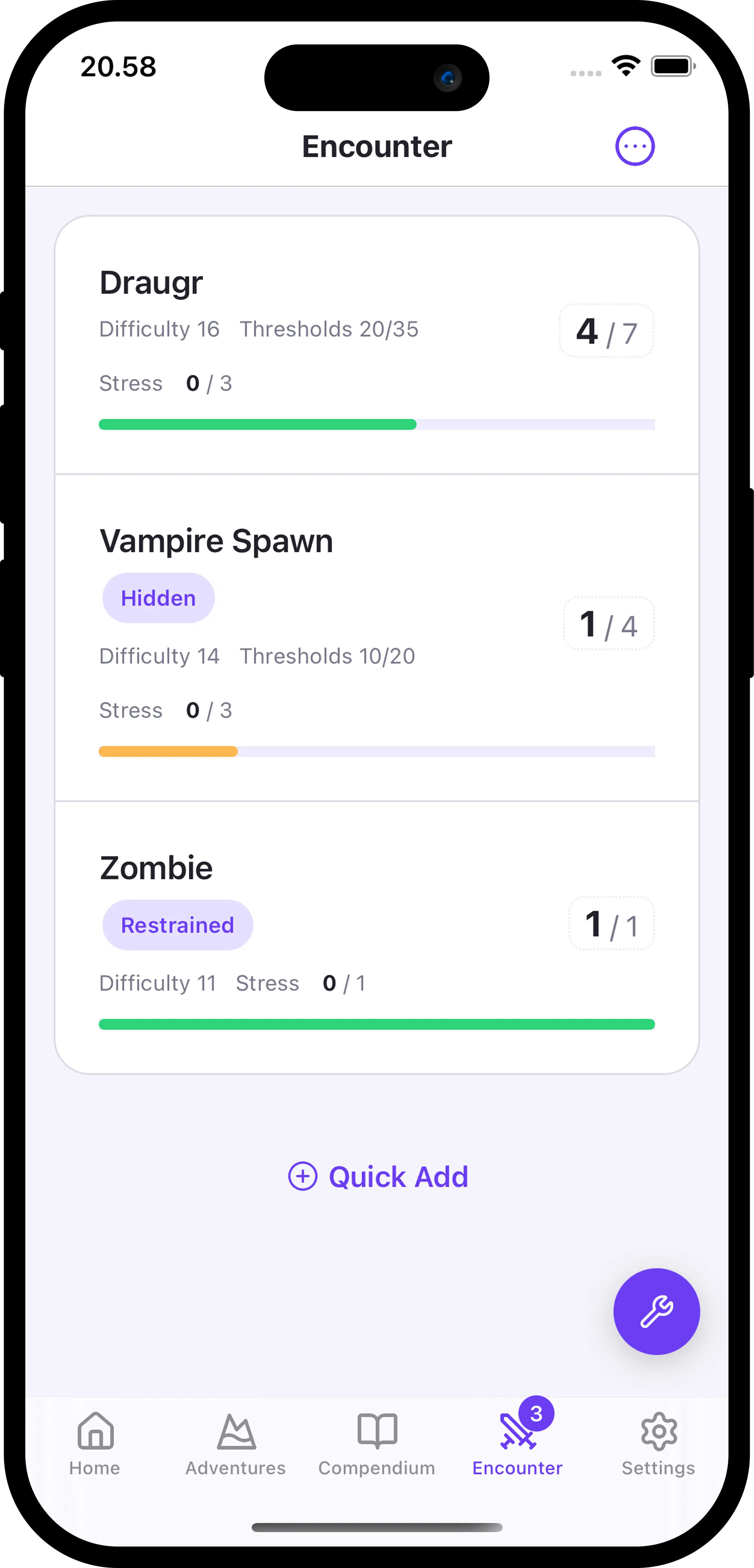
Adversaries are simpler than player characters: HP, one or two attacks with a flat damage value, and a special move triggered by Fear. Do not play them mechanically. Play their goals. A cornered beast fights desperately to escape. A calculating villain targets the most isolated character first. Mercenaries may break morale if their leader falls.
When an adversary reaches zero HP, they are defeated, and you narrate how to match the tone of the scene. Some flee, some surrender, some explode spectacularly. The system does not demand a specific outcome. It just requires that the adversary stops being a threat.