
Daggerheart Character Creation: A Step-by-Step Guide
Creating a Daggerheart character takes about twenty minutes the first time and gets faster once you know the rhythm. The process moves through five choices, each building on the last, so work through them in order.

Here is the full sequence at a glance.
| Step | What you decide |
|---|---|
| 1. Ancestry & community | Where your hero comes from, and one mechanical hook from each. |
| 2. Class & subclass | Your core identity, traits, and which domains you draw from. |
| 3. Traits | A spread of modifiers across the six traits. |
| 4. Domain cards | Your starting hand of abilities. |
| 5. Equipment & background | Weapons, armor, and who your hero is. |
Step 1: Pick ancestry and community
Your ancestry describes your character's heritage: elf, dwarf, human, faun, or one of several others. Each ancestry provides a passive trait or ability, and some grant minor adjustments to specific rolls. Ancestry is not a rigid cage. It gives flavor and one mechanical hook.
Your community is equally important and often more immediately useful. It represents where and how you grew up: in a sprawling city, a remote homestead, a travelling caravan, or a scholarly order. Each community provides a starting skill and a background ability that reflects the habits of that upbringing. Together, ancestry and community give your character a sense of origin before you pick up a weapon or spell.
Step 2: Choose your class and subclass
Your class is your primary mechanical identity. Daggerheart classes include the Bard, Guardian, Ranger, Rogue, Seraph, Sorcerer, Warrior, Wizard, and Druid, among others. Each class sets your base HP, Stress thresholds, primary and secondary traits, and the domains you draw cards from.
At creation you also pick a subclass, which specializes your class in a direction. A Warrior might be a Stalwart, defensive and shielding allies, or a Beastbound, fighting alongside an animal companion. You gain a foundation ability immediately and unlock later abilities at milestones.
Step 3: Assign trait scores
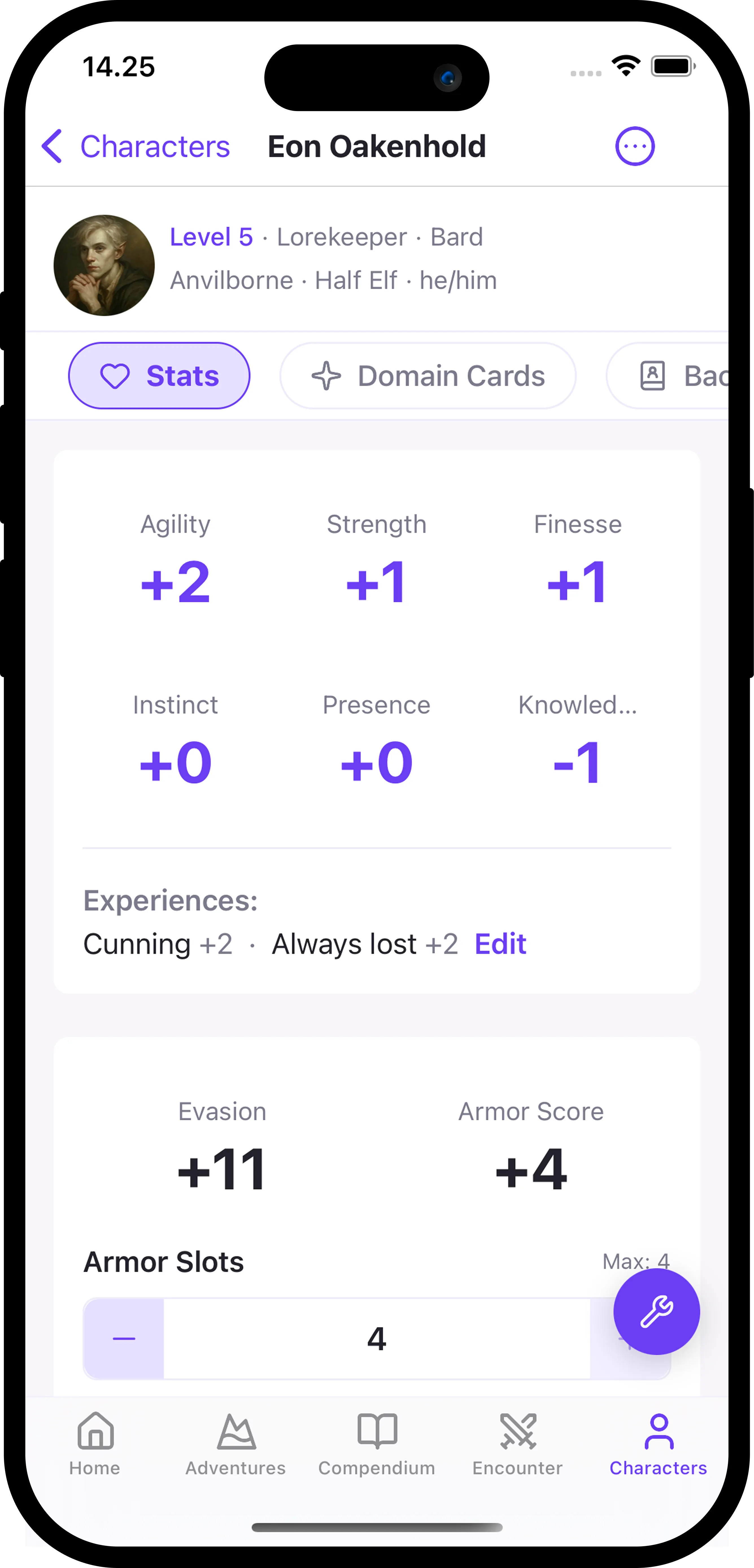
Daggerheart uses six traits: Agility, Strength, Finesse, Instinct, Presence, and Knowledge. Your class names two as primary (higher modifier) and the rest as secondary. You distribute scores across them using a spread suggested by your class. Modifiers run from −2 to +4.
Rule of thumb
Most starting heroes have one trait at +2, one at +1, and the rest lower. Resist the urge to min-max. Because you add the modifier to the higher Duality die, even a +0 rarely produces a disaster, and traits grow at milestones anyway.
Step 4: Select domain cards
Domain cards are Daggerheart's version of spells, special abilities, and feats, presented as a hand you draw from and manage during play. Your class tells you which domains you can access and how many cards you start with. Common domains include Arcana, Blade, Bone, Codex, Grace, Midnight, Sage, Splendor, and Valor.
Aim for a mix: at least one active ability for combat, one that shines outside of combat, and one passive or reaction card that works quietly in the background. You will swap and add cards at milestones, so do not agonize over perfection. Choose cards that match the story you want to tell right now.
Step 5: Gear up and write your background
Your class and community each contribute starting equipment: weapons, armor, tools, or coin. Weapons have a damage die and a trait they use to attack. Armor provides a flat damage reduction. Equipment lists are intentionally short, because Daggerheart does not weigh characters down with encumbrance.
Finally, spend five minutes writing two or three sentences about who your character is beyond the mechanics. What do they want? What are they afraid of? What do they owe, and to whom?
A character with a personal stake is more interesting than one with optimized numbers.
Daggerheart is built around collaborative storytelling, and the GM will use those seeds to create moments that matter to your character specifically. The numbers get you into the fight. The background is what makes the fight mean something.